
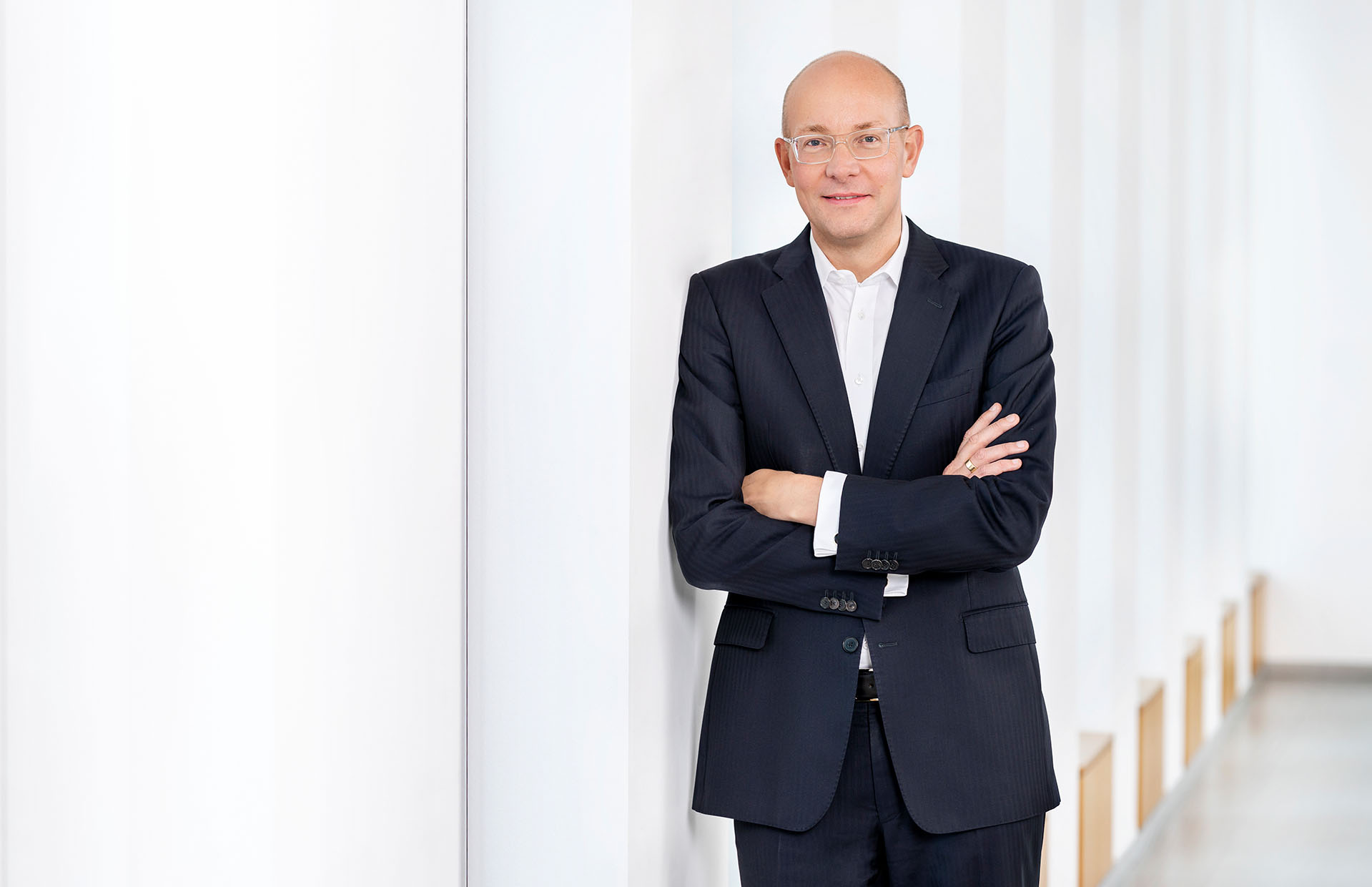
Dear Shareholders,
The DZ BANK Group can look back on 2025 as an exceptionally good year. Profit before taxes amounted to €4.3 billion, significantly exceeding the prior year (2024: €3.3 billion). Combined with our capital base, this result sees us well equipped to actively shape our growth going forward, and therefore our future. This very encouraging performance was based on healthy customer business in almost every segment. More than ever, our shared success is founded on close collaboration with the cooperative banks. An exceptionally strong contribution in the reporting year has been made by the insurance segment thanks to its very good operating performance and a favorable claims environment.
The German economy faced several major challenges at once in 2025. Global conflicts and trade barriers led to uncertainty in economic relationships and weighed on German companies’ export activities. Although energy prices stabilized, production costs continued to have a noticeable adverse impact on industry. Overall, the economy recorded only low growth despite support from stimulus packages. In contrast, the stock markets continued to show a high level of resilience and followed a positive trajectory.
In this environment, the DZ BANK Group’s diversified business model proved its strength and adaptability. R+V Versicherung in particular made a decisive contribution to the very good overall results due to rising premiums and an unusually low claims rate in non-life insurance and reinsurance. Union Investment continued to see volume growth that was comparable to that of recent years and achieved another excellent profit before taxes, supported by the upbeat stock markets. In the banking business, DZ BANK – central institution and corporate bank strengthened its role as a reliable partner to our customers. On the whole, companies were reluctant to invest, which meant the focus was on solutions for working capital and liquidity. Nevertheless, DZ BANK – central institution and corporate bank was able to increase its lending volume by 8 percent. Given the volatility of the markets, products to hedge against currency risks once again proved popular with corporate customers. Sales of money market products stood at a good level in all customer segments. In the Capital Markets business line, business with institutional customers was also very successful due to governments’ strong demand for funding. Within the Transaction Banking business line, both payments processing and the volume of funds in the depository business saw growth. DZ HYP’s operational business performance was stable. Valuation effects relating to own issues led to a lower profit before taxes compared to the previous year. DZ PRIVATBANK continued to increase its customer business and was able to maintain its profit before taxes at almost the prior-year level despite the fall in interest rates. For TeamBank and VR Smart Finanz, the ongoing weakness of the German economy remained a detrimental factor that was reflected in the loss before taxes that these two group entities reported.
"The DZ BANK Group can look back on 2025 as an exceptionally good year. Profit before taxes amounted to €4.3 billion, exceeding the prior year (2024: €3.3 billion)."
The key results in detail:
The DZ BANK Group’s net interest income amounted to €3.84 billion. This was significantly lower than the figure for the prior year (2024: €4.67 billion), which had been unusually high due to accounting-related effects that had a positive impact on net interest income but a countervailing negative impact on gains and losses on trading activities. Customer business performed well, with the central institution and corporate bank, DZ HYP, and Bausparkasse Schwäbisch Hall making a particularly strong contribution to net interest income. Net fee and commission income rose to €3.37 billion (2024: €3.19 billion). This was primarily due to robust inflows into fund products at Union Investment and also to the customer business at the central institution and corporate bank. Gains and losses on trading activities amounted to a net gain of €281 million (2024: net loss of €842 million). In the prior year, gains and losses on trading activities had been adversely impacted by negative valuation effects relating to own issues at the central institution and corporate bank and by accounting-related effects. The central institution and corporate bank’s capital markets business continued to perform well in all customer segments. Gains and losses on investments improved to a net gain of €105 million (2024: net gain of €65 million). Other gains and losses on valuation of financial instruments deteriorated to a net loss of €127 million (2024: net gain of €229 million) owing to negative valuation effects. Due to a strong rise in premiums coupled with a low volume of claims in non-life insurance and reinsurance, net income from insurance business rose to €2.02 billion (2024: €1.15 billion). Loss allowances came to €653 million (2024: €845 million) and remained unremarkable in most areas of the DZ BANK Group. The weak economic climate was only evident at TeamBank and VR Smart Finanz. Increased investment in personnel and IT infrastructure meant that administrative expenses rose to €4.80 billion (2024: €4.55 billion).
The DZ BANK Group’s capital adequacy remains very good, with a common equity Tier 1 capital ratio of 18.4 percent. This strong increase compared to the prior year (December 31, 2024: 15.8 percent) was due in part to Capital Requirements Regulation III, which came into force at the start of 2025.
This record financial performance reflects the hard work of all employees of the DZ BANK Group. On behalf of the entire Board of Managing Directors, I would like to express our deepest gratitude to them.
Given this positive performance, our shareholders will be benefiting appropriately. In keeping with the principles of responsible capital management, we will once again propose a dividend of 25 cents per share to the Annual General Meeting.
Although tensions continue to run high in the international arena, the first weeks of 2026 saw a positive trend overall, including brisk funding activities in the capital markets. The German economy is also starting to send out positive signals. The ZEW index, for example, rose significantly at the start of the year. Stimulus from the German government’s special off-budget infrastructure fund should play a particularly key role in the anticipated recovery and could also revive foreign investors’ interest in Germany. However, these investors are now rightly expecting to see the imminent arrival of reforms and actual projects – in areas such as infrastructure – in which they can invest. Our economists are predicting growth of 1.2 percent for the German economy. In terms of our own results, we are unlikely to see a repetition of the one-off items that had a positive effect in 2025, particularly in the insurance segment. On this basis, we anticipate a profit before taxes for 2026 of around €3.0 billion.
"We must do more than just decisively tackle Germany’s structural weaknesses. We also need a change of mindset. We need the willingness to make up ground rather than simply defend our position."
The DZ BANK Group is channeling its efforts into strengthening its market position. To this end, we are expanding our presence and our service offering in international business, especially in key growth markets. We are also enhancing our products and services with regard to digitalization and the tokenization of assets. We firmly believe that these technologies will become established as a core element of modern financial market infrastructure. That is why DZ BANK Group began working in this area at an early stage and has been successfully implementing projects in the capital markets for years, for example on the basis of distributed ledger technology. With “meinKrypto” we have created a service that enables retail customers of cooperative banks to trade cryptoassets. Our participation in Qivalis, a European consortium to launch a euro-pegged stablecoin, underlines our ambition in this fast-moving ecosystem.
These and other innovations require robust foundations, which is why we continually invest in our digital infrastructure. We are also forging ahead with the deployment of innovative technologies of the future, such as generative artificial intelligence. Our focus is on boosting our group’s ability to innovate and on making our service provision even more efficient.
As a nation, Germany needs to face the facts and internalize some uncomfortable truths. We have always thought of ourselves as a country that sets the global standards in many fields. But today, regardless of specific areas of excellence, we are confronted with a change to our competitive position. Compared to the countries that we should be using as benchmarks, we are seeing a relative loss of prosperity. These days, we have a lot to learn from others. We must do more than just decisively tackle Germany’s structural weaknesses. We also need a change of mindset. We need the willingness to make up ground rather than simply defend our position. This is the only option if we are to secure tomorrow’s growth.
The Cooperative Financial Network has the capability and the broad impact to be able to actively support Germany’s economic renewal.
Kind regards,
Dr. Cornelius Riese
Chief Executive Officer